Choose the decision you need to make
Quality review needs several focused passes rather than one impression of whether a film looks good. Check facts, story clarity, visual continuity, audio and publication materials separately. Give every issue a timestamp or source reference and assign a person to resolve it. These guides are practical editorial checklists, not certifications of legal clearance, accessibility conformance or factual accuracy. The relevant reviewer must inspect the actual final deliverable, not only the intended prompt.
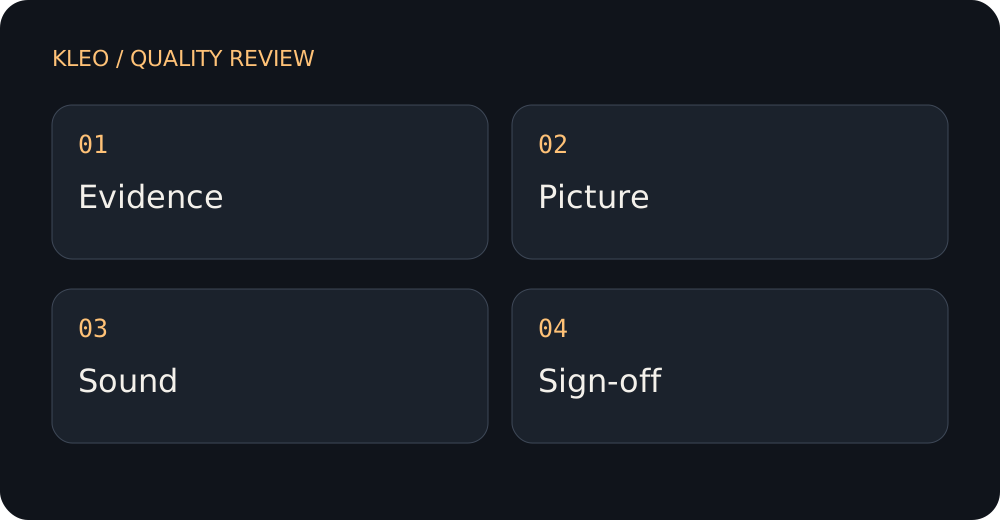
Factual review compares the final spoken and visual claims with their evidence. An approved script is only the starting point: generated visuals or later edits can introduce implications that were never checked.
Visual review looks for distortions that distract from the story or change its meaning. Check the whole film at normal speed, then inspect suspicious moments rather than treating a single attractive frame as approval.
A mobile review tests whether the intended message survives smaller viewing conditions. Important action, captions and added text may be readable on a large monitor but unclear in the actual feed.
Watching without audio reveals whether the sequence communicates its basic actions and whether important context depends entirely on narration. It is a diagnostic pass, not a requirement that every narrated film tell its complete argument silently.
A brief-compliance review compares the actual deliverable with explicit requirements. Separate factual or contractual requirements from subjective preferences so that approval does not become an endless search for a different mood.
A film can quote an accurate statement while presenting it in a misleading context. Review the source's scope, date, uncertainty and intended population before turning a narrow finding into a broad conclusion.
A generated reconstruction should not be presented as a recording of the event it illustrates. Decide how viewers will understand the status of the images through the narration, visible labels added in editing and the publication context.
An asset record connects each externally supplied image, audio file or quotation with its origin and permitted use. It helps the publishing team avoid treating available material as automatically cleared for a new project.
Separate review rounds by purpose: first the story and facts, then the render, then the publication package. A single unstructured comment thread can mix essential corrections with incompatible personal preferences.
The final file should be checked for playback, duration, framing, sound and completeness. Treat advertised output specifications as expectations to verify, not as proof of the properties of a particular downloaded MP4.
Release approval should cover the film, title, description, captions, thumbnail and destination. Changes made after the video review can introduce new claims or reveal information that was not approved.
Move through the production
Browse all production topics or read the complete Kleo workflow. Choose guides by the decision at hand, then keep your approved choices with the project.