Choose the decision you need to make
Story planning is about relationships between events. Start with the guide matching your actual problem: an unclear opening, disconnected scenes, an arbitrary ending or a series with overlapping episodes. The fictional examples demonstrate a planning technique; they are not claims about films already rendered by Kleo. Review the treatment as a whole before approving production, because an attractive individual shot cannot supply a missing cause or consequence.
An opening hook creates a specific question the film will answer. It can be an unexpected action, a visible problem or a clear contrast; it does not require a sensational claim or a promise the story cannot keep.
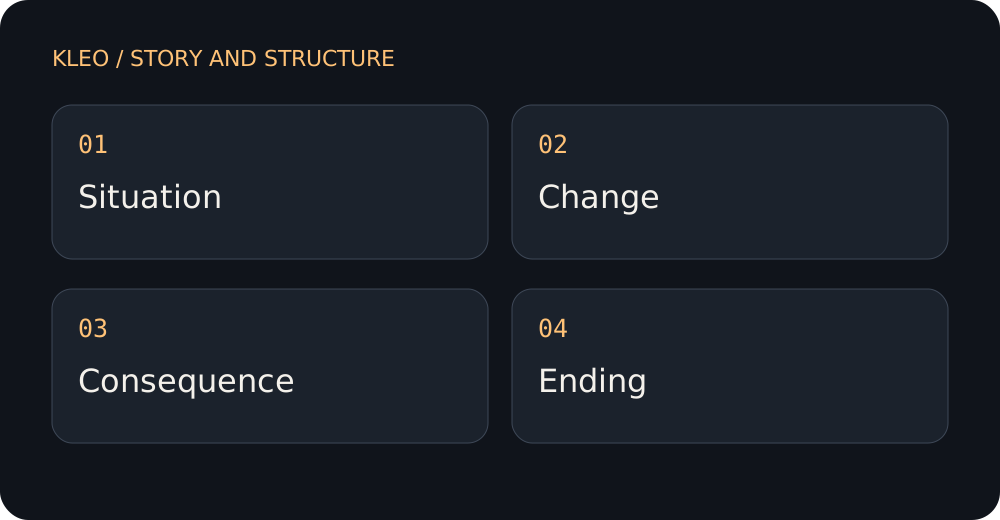
Three acts can organize a short film as a situation, a change and a consequence. They are a planning tool, not a requirement for equal-length sections or a rigid formula imposed on every subject.
A sequence becomes easier to follow when each event changes what can happen next. Replace a list of attractive images with decisions and consequences that the viewer can connect.
A visual payoff gives an earlier object, action or composition new meaning. The audience needs to notice the setup without being told the ending in advance.
A factual story can follow a question, evidence and conclusion without inventing private conversations or personal motives. Organize verified material into a clear sequence and mark illustration as illustration.
A single-location story concentrates attention on changes inside a stable space. It can reduce unnecessary scene complexity, but the room still needs a meaningful action rather than a static description.
An object-led film follows a visible item's changing role. It works when the viewer can track the same object and understand what each encounter adds to its meaning.
Parallel storylines need distinct visual identities and an understandable reason to alternate. If the viewer spends the whole film identifying who is where, simplify to one thread.
An ending should complete the promise of the opening and leave one useful idea. Repeating the whole script can weaken a short film when the final image already communicates the result.
A video series needs a repeatable promise and a different question in each episode. Reusing a visual structure can help recognition, but rephrasing the same answer does not create useful new episodes.
Scene density is the amount of new action and information a viewer must process at once. A brief becomes easier to render and review when each shot has one dominant event.
Move through the production
Browse all production topics or read the complete Kleo workflow. Choose guides by the decision at hand, then keep your approved choices with the project.